These skills enable AI agents to perform complex, data-intensive operations across various platforms, enhancing their utility for businesses and developers. They integrate with popular AI coding assistants like Claude Code, Cursor, Codex, and Gemini CLI, allowing developers to augment their AI tools with robust automation features.
What Are Apify's Agent Skills?
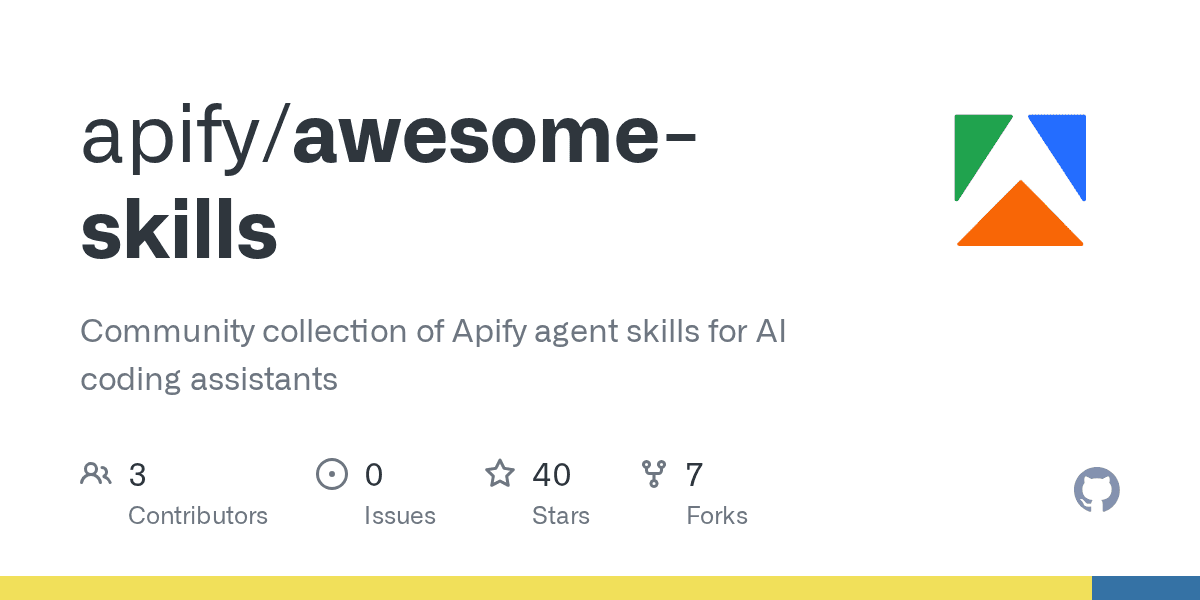
Apify's Awesome Skills are a set of modular, pre-defined functionalities that an AI assistant can invoke to interact with the web programmatically. Instead of teaching an AI how to perform detailed web scraping from scratch, these skills provide a ready-made solution for common data extraction needs. Each skill is designed to target specific platforms and data types, ranging from social media analytics to comprehensive e-commerce data collection.
For instance, the `apify-ecommerce` skill can scrape product data for pricing intelligence and supply chain monitoring across over 50 marketplaces, including Amazon, Walmart, eBay, and IKEA, according to the repository's README. Other specialized skills include `apify-lead-generation`, which extracts B2B/B2C contacts from platforms like Google Maps and LinkedIn, and `apify-brand-reputation-monitoring`, which tracks reviews and sentiment across major social media sites and review platforms. This approach allows AI assistants to become highly specialized tools for extracting structured data from unstructured web content.
Empowering AI Assistants for Data-Rich Tasks
The design philosophy behind Apify's skills aligns with the "thin harness, fat skills" model for AI agents. This concept posits that an effective AI agent (the "harness") should orchestrate specialized, powerful tools (the "skills") rather than trying to do everything itself.
"The harness runs the model in a loop, manages context, reads and writes files, and enforces safety."Apify's collection provides these "fat skills," enabling AI assistants to tackle data challenges with pre-packaged expertise. For example, a developer using Gemini CLI can point their agent to the `gemini-extension.json` file in the repository, automatically granting it access to these capabilities. Similarly, other AI tools that support Markdown context can utilize the skills by referencing the auto-generated skill index found in `agents/AGENTS.md`. This structured approach reduces the complexity for developers, allowing AI to execute sophisticated web tasks with minimal configuration.
— Garry Tan, Y Combinator CEO
To use these skills, users require an Apify account and an API token, which handles authentication and billing for the underlying Apify Actors. The platform operates on a pay-per-result pricing model, meaning users pay only for the data extracted. This makes advanced web data extraction accessible to AI agents without requiring extensive infrastructure setup.
The Trending Society Take
For AI founders and builders, Apify's Awesome Skills repository represents a critical component in developing truly agentic AI. It provides a blueprint for how AI can move beyond conversation to tangible action, offering pre-built "superpowers" that drastically cut development time for data-intensive applications. Integrating such specialized tools is how developers unlock the next generation of AI productivity, transforming AI assistants into indispensable operational assets.