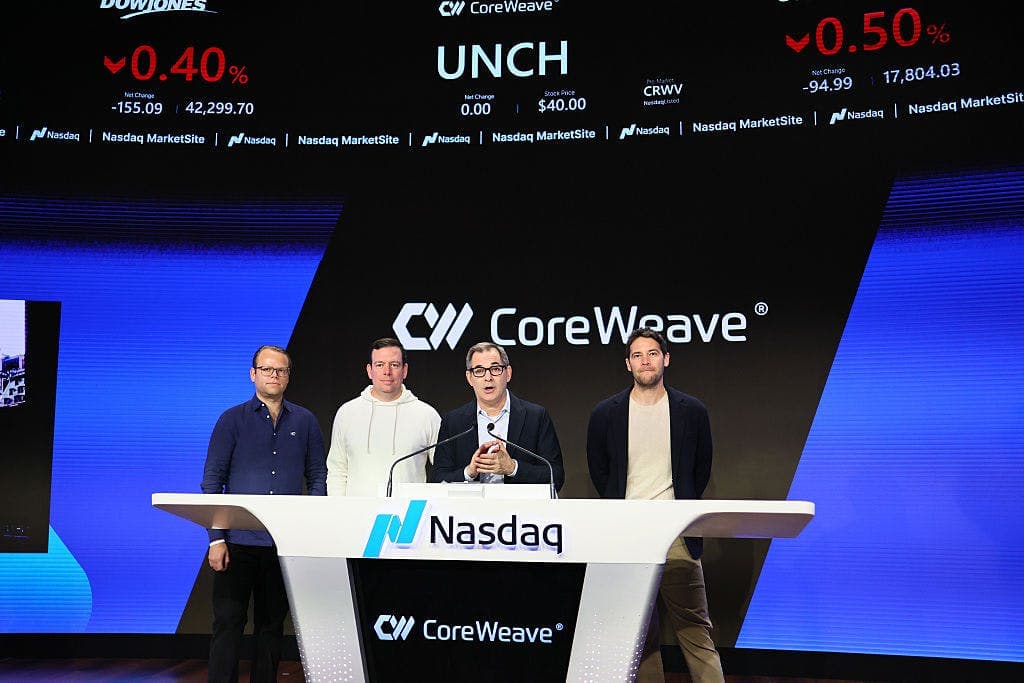

AI cloud provider CoreWeave has inked a multi-year deal with Perplexity AI, providing dedicated Nvidia Grace Blackwell-powered clusters for the AI answer engine's inference workloads. This partnership highlights the intense demand for specialized AI compute infrastructure while CoreWeave navigates rapid expansion and significant capital expenditures, reflecting a dynamic yet challenging market for AI upstarts.
CoreWeave Fuels Perplexity's AI Ambitions
The specialized AI cloud provider CoreWeave announced a multi-year strategic partnership with Perplexity AI, the increasingly popular AI answer engine. Under the agreement, CoreWeave will provide its compute infrastructure, specifically dedicated Nvidia Grace Blackwell-powered clusters, to support Perplexity's AI inference workloads . This move is critical for Perplexity as it scales its operations, requiring robust and specialized hardware to deliver quick, accurate responses.CoreWeave's CEO, Mike Intrator, emphasized that this partnership reflects a broader trend of emerging AI leaders adopting their platform. "Like many others, they choose us for our unified AI cloud platform — not just access to capacity — and that is building a more diversified CoreWeave business," Intrator stated. Perplexity cited performance as a key driver behind its decision to select CoreWeave, indicating the importance of optimized infrastructure for cutting-edge AI services. The deal also includes CoreWeave adopting Perplexity Enterprise Max, enabling its workforce to search across web and internal documents.
This announcement comes as CoreWeave navigates significant growth alongside increasing financial demands. The company reported a substantial increase in revenue, which more than doubled year-over-year in the fourth quarter, reaching$1.57 billion
. Its revenue backlog also surged to $66.8 billion by the end of December. However, this aggressive expansion comes with a cost: CoreWeave's net losses ballooned to $284 million in the fourth quarter, up from $36 million in the same period last year. The company anticipates its capital expenses to double as it scales its AI cloud platform to meet the enormous computing power required for training and deploying advanced AI models.The Shifting Tides for Software Development
While AI infrastructure providers like CoreWeave are thriving on demand, other sectors of the tech industry are grappling with the implications of advanced AI. Shares of software development service GitLab (GTLB) tumbled significantly following lackluster guidance, contributing to a roughly 60% decline in its stock price over the last year. This downturn is largely attributed to a "death-of-human-coding" narrative taking hold among investors.The core concern is that GitLab sells tools and services traditionally used by human coders and developers. With rapid advancements in AI coding, exemplified by programs such as Claude Code, investors fear a future with significantly fewer human programmers requiring these services. Further compounding this anxiety, a report from The Information indicates that OpenAI is developing an alternative to Microsoft's GitHub, which, like GitLab, offers code repositories and collaborative software development tools. While the complete obsolescence of human coders isn't a foregone conclusion, the perceived reduction in demand for their numbers is reshaping investment in companies that serve them.
AI's Intricate Dance with Government and Defense
The integration of AI into critical national infrastructure and defense systems is also creating complex dynamics. Palantir Technologies (PLTR), a major government contractor known for its data analysis software, may face strained ties with AI lab Anthropic. This potential separation stems from an order by Defense Secretary Pete Hegseth, who reportedly declared that his department would restrict military contractors from using Anthropic's technology. Anthropic's AI models are deeply embedded within the Palantir software packages utilized by the U.S. government for analyzing classified data, making this a significant operational challenge.Alex Karp, CEO of Palantir, recently criticized what he perceived as Silicon Valley's resistance to supporting the U.S. military. Speaking at a defense tech summit, Karp warned that AI companies going against the military risk angering both liberals and conservatives, potentially leading to the nationalization of their technology. "If Silicon Valley believes we are going to take everyone’s white-collar jobs… and you’re going to screw the military, if you don’t think that’s going to lead to the nationalization of our technology, you’re retarded," Karp reportedly said, emphasizing the precarious position of tech companies in the defense sector.
Broader Market Movements: Retail and Crypto Rebounds
Beyond the immediate AI narrative, other market segments show divergent trends. Off-price retailer Ross Stores (ROST) saw its shares climb over 6% after reporting stronger-than-expected fourth-quarter sales. The company posted adjusted earnings of $2 per share, surpassing Wall Street expectations of $1.90, with total sales increasing 12% year-over-year to $6.6 billion. CEO Jim Conroy attributed some of this success to growth among 18- to 34-year-old customers.Meanwhile, crypto-adjacent stocks experienced a rebound as Bitcoin soared above $70,000, exceeding a key resistance area. Companies like Strategy and Strive Inc., MARA Holdings, Riot Platforms, Coinbase (COIN), and Robinhood Markets (HOOD) all saw gains. This rally coincides with a broader market reversal influenced by heightened geopolitical risk, suggesting a rotation into different asset classes after Bitcoin's challenging performance earlier in 2026, when it was down nearly 50% from its October peak.