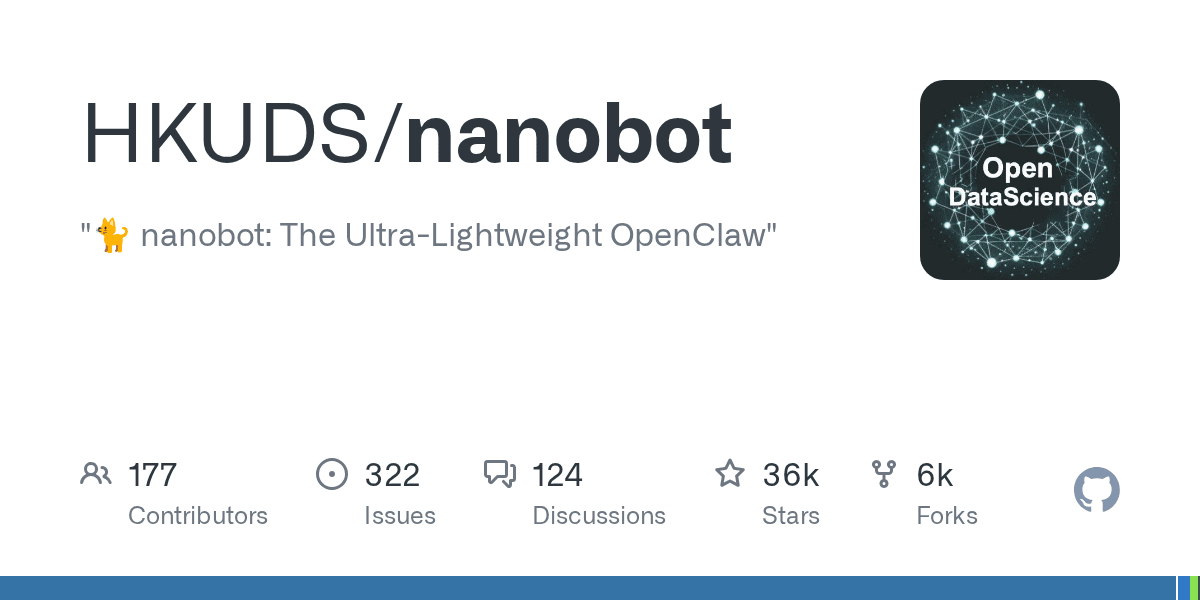
An ultra-lightweight AI assistant called nanobot emerges as a streamlined alternative to the popular, but complex, OpenClaw framework, delivering core agent functionality with 99% fewer lines of code. This open-source project directly addresses the growing demand for local, controllable AI agents, allowing developers to deploy robust personal assistants across numerous chat platforms with minimal overhead and enhanced security, according to its GitHub repository.
The rise of agentic AI frameworks like OpenClaw has been significant, with Nvidia CEO Jensen Huang likening it to Linux in its potential to transform the AI landscape. OpenClaw enables developers to build AI agents that plan, decide, and execute tasks independently, offering a cost-effective alternative to proprietary cloud models. However, its complexity and security concerns, especially after nearly 23,000 users in China had assets exposed, have highlighted the need for more manageable solutions, per CNBC.
What Makes Nanobot an Agentic AI Powerhouse?
Imagine having a full-scale AI factory, capable of handling complex operations, but realizing you only need a specialized, highly efficient workshop. OpenClaw is that factory, comprehensive but resource-intensive. Nanobot, by contrast, is the workshop: it focuses on the essential tools and processes, making it dramatically smaller, faster, and easier to manage for personal AI assistant tasks. This lean approach allows for rapid deployment and lower resource consumption, making advanced AI agent capabilities accessible on personal machines.
Nanobot provides a robust foundation for building autonomous AI agents by supporting a wide array of Large Language Model (LLM) providers and communication channels. Users can connect to major LLM services like OpenAI, Anthropic, DeepSeek, and Google Gemini, or leverage local solutions such as Ollama, vLLM, and OpenVINO Model Server. This flexibility means developers can choose their preferred models, including those running on local hardware, ensuring data privacy and reducing cloud costs.
The tool supports integration with 13 different chat platforms, including Telegram, Discord, WhatsApp, Slack, Email, and Feishu. Each integration comes with clear setup instructions, often involving bot tokens and API keys. The inclusion of an interactive setup wizard (`nanobot onboard --wizard`) streamlines the initial configuration, allowing users to select providers and models quickly.
Developer Control and Enhanced Security
Nanobot prioritizes security and developer control. The project recently removed a `litellm` dependency due to supply chain poisoning concerns, replacing it with native OpenAI and Anthropic SDKs. This ensures a more secure and transparent dependency chain. Developers can further enhance security by setting `restrictToWorkspace: true` in the configuration, which sandboxes all agent tools like shell execution and file operations to a specific directory. This prevents path traversal and out-of-scope access, a critical feature for locally running AI agents.
The framework also supports Model Context Protocol (MCP) servers, allowing external tool servers to integrate as native agent tools. This means a `nanobot` instance can communicate and utilize tools from other agents in a secure, standardized manner. For scalability and isolation, `nanobot` supports running multiple instances simultaneously, each with its own configuration and runtime data. This feature is particularly useful for managing separate bots for different platforms or isolating testing and production environments.
Nanobot’s focus on being ultra-lightweight and highly configurable positions it as a practical choice for developers. While OpenClaw's broader capabilities ignited the agentic AI movement, `nanobot` offers a focused, secure, and efficient path for creating personal AI assistants. This approach gives developers more control over their AI infrastructure, steering away from reliance on large, opaque proprietary models.