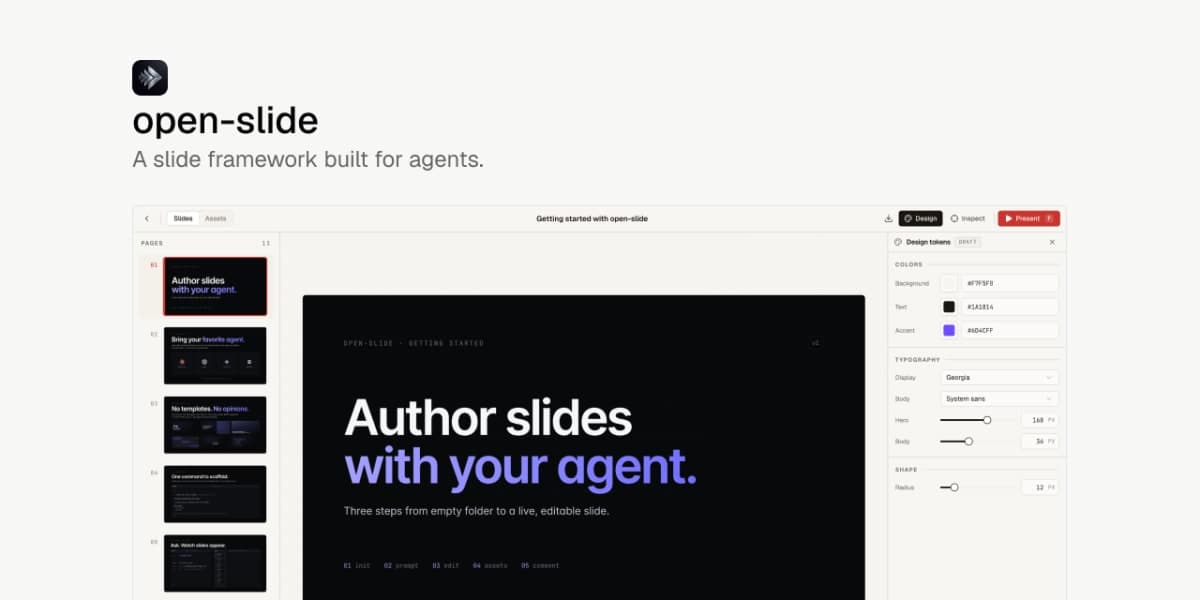
Open-Slide is a new open-source framework that allows AI coding agents to build complete, professional slide decks from natural language prompts. Released in May 2026, it provides a runtime that handles the canvas, navigation, and styling, allowing the agent to focus solely on generating content as React components, according to the project's GitHub repository.
This framework transforms the tedious process of creating presentations. Instead of manually designing slides, a user can provide a simple description like "make slides about AI agents," and the tool handles the rest. It bridges the gap between a high-level idea and a polished, presentable deck without the user needing to write code directly.
The project is part of a larger movement to equip AI with more specialized, actionable capabilities. While tools like Gemini CLI bring AI to the terminal, Open-Slide gives agents a visual canvas to work on, turning them from code writers into visual content creators.
How Does Agent-Driven Authoring Work?
Open-Slide is designed for an agent-native workflow, treating the AI as the primary author. The process starts with a command-line scaffolder that creates a new project. From there, a developer uses natural language commands within their chat-based AI agent, such as Claude, to drive development.
The framework ships with built-in "skills" for the agent:
- /create-slide: This command initiates a dialogue where the agent asks for the topic, desired aesthetic, page count, and text density. It then plans the deck's structure and writes the code for each slide.
- /apply-comments: This enables a rapid feedback loop. While viewing the deck in a browser, a user can click on any element and leave a comment like "make this headline bigger" or "change this image." Running the command instructs the agent to implement all pending changes.
This interactive loop—present, comment, and apply—allows for quick, iterative refinements directly from the presentation view. The framework, according to its documentation on GitHub, standardizes the workspace so the agent knows exactly how to operate. Every slide renders into a fixed 1920 × 1080 canvas, with predefined rules for typography and layout.
What Features Create a Professional Deck?
Beyond basic slide generation, Open-Slide includes a suite of tools aimed at producing polished, stage-ready presentations. It is not just about generating text on a slide; it's a complete runtime environment for visual communication.
An integrated assets manager allows for handling images and fonts on a per-deck basis. A key feature is its integration with the svgl catalogue, enabling users to search for and insert any brand's SVG logo directly into a slide without leaving the editor. This solves a common and frustrating part of creating corporate or technical presentations.
For delivery, the framework includes a professional presenter mode with a split view showing the current slide, the next slide, speaker notes, and a timer. When finished, the entire deck can be exported as a self-contained static HTML website or a print-ready PDF. Because the output is a plain static build, it can be deployed with one click to services like Vercel or Cloudflare Pages, requiring no server or complex backend.
The Trending Society Take
Open-Slide is more than just a developer tool; it is a preview of the next wave of AI-native products. The real innovation is abstracting the "boring" parts of a task—like canvas scaling, navigation, and build configurations—to create a constrained, predictable environment where an AI agent can reliably succeed. It signals a shift from general-purpose chatbots to specialized agents that perform concrete, revenue-generating work.
As startups like CopilotKit raise capital to help developers build in-app agents that manipulate user interfaces, Open-Slide provides a tangible example of this trend in action. It demonstrates that the future of agentic workflows involves AI moving beyond text-in, text-out interactions to become true collaborators in visual and structural tasks. For builders in the AI space, the lesson is clear: find a high-value, tedious workflow and build the perfect runtime for an agent to automate it.