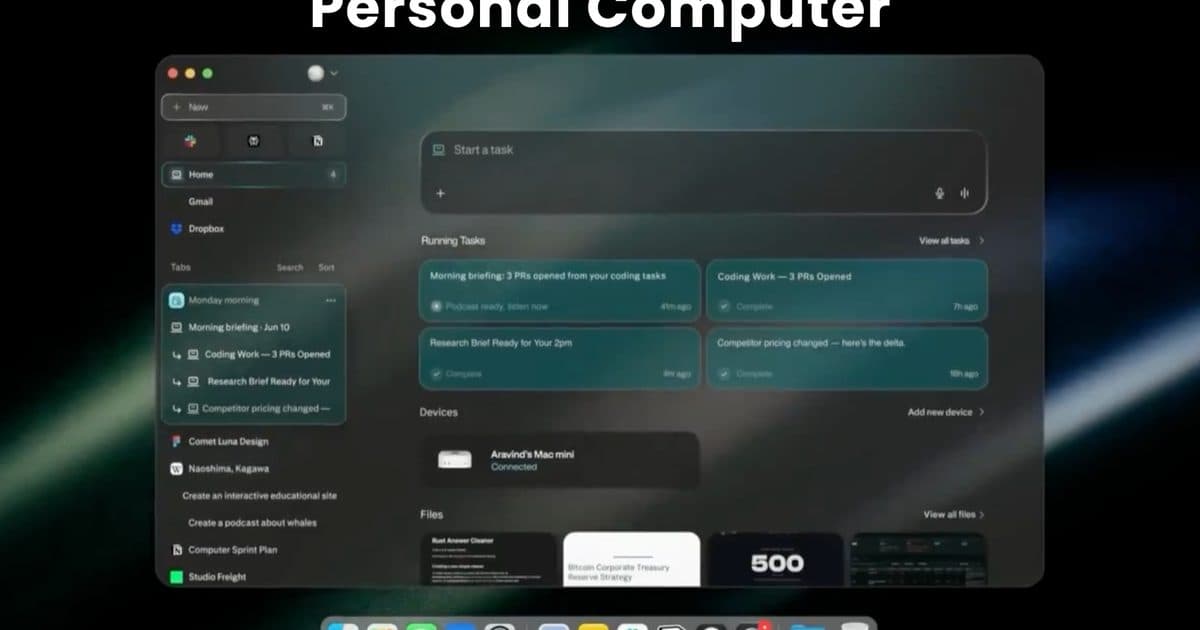

The obvious question for many developers and businesses is security. Perplexity asserts that every task performed by Personal Computer executes within a sandboxed cloud environment. Each task gets its own isolated filesystem and browser, preventing the AI from "going rogue" through your local directories. Furthermore, every action requires explicit user confirmation, and a built-in audit trail logs every command, providing transparency and control. You're not just screen-sharing into a Mac; you're directing a sophisticated AI agent running on it remotely, while you focus on other priorities.
Transforming Workflows with Autonomous Agents
This shift from instruction-following to objective-driven AI is significant. A developer could instruct Personal Computer to monitor a GitHub repository overnight for new commits and then drop a formatted summary into a Slack channel before the daily standup, eliminating manual scripting or last-minute panic. Researchers could hand it a messy, half-formed topic before bed and wake up to a structured report compiled from live sources, sitting in their inbox without late-night rabbit holes or dozens of open browser tabs.For small business owners, the value proposition arguably becomes even stronger. Imagine pointing Personal Computer at your Gmail account and telling it to watch for client inquiries, draft replies based on your past communications, and only alert you when human intervention is absolutely essential. It connects to a suite of popular services, including Gmail, Slack, GitHub, Notion, and Salesforce, enabling it to monitor triggers and execute proactive tasks across them. As Aravind Srinivas, CEO of Perplexity, stated at the conference, "A traditional operating system takes instructions; an AI operating system takes objectives."
However, the path for AI agents isn't entirely clear. Just recently, a federal judge blocked Perplexity's Comet web browser agent from making purchases on Amazon.com without Amazon's authorization, according to Bloomberg. While Personal Computer emphasizes user control and audit trails, this ruling highlights the ongoing legal and ethical complexities surrounding autonomous AI actions, especially when interacting with third-party platforms. It signals that user consent, while important, does not always override platform terms of service or a company's right to control access to its systems.
Who Is Perplexity's Personal Computer For?
Access to Personal Computer is currently limited to Perplexity Max subscribers, costing $200 a month. At launch, it's Mac-only and available via a waitlist. Subscribers receive 10,000 monthly credits for computational tasks. The enterprise version of Personal Computer is set to include additional security controls, compliance features, and single sign-on, clearly signaling Perplexity's dual focus on power users and corporate clients.While individuals will undoubtedly find innovative uses, the steep $200 monthly price tag reveals the true target audience: businesses. This isn't consumer-grade automation dressed up for the enterprise; it's the other way around. The real "unlocks" are geared towards teams drowning in repetitive workflows, founders who cannot yet afford to scale their human workforce, and operations relying on piecemeal solutions. Nothing else on the market combines this level of local-cloud integration with such a diverse array of models and hands-off execution.