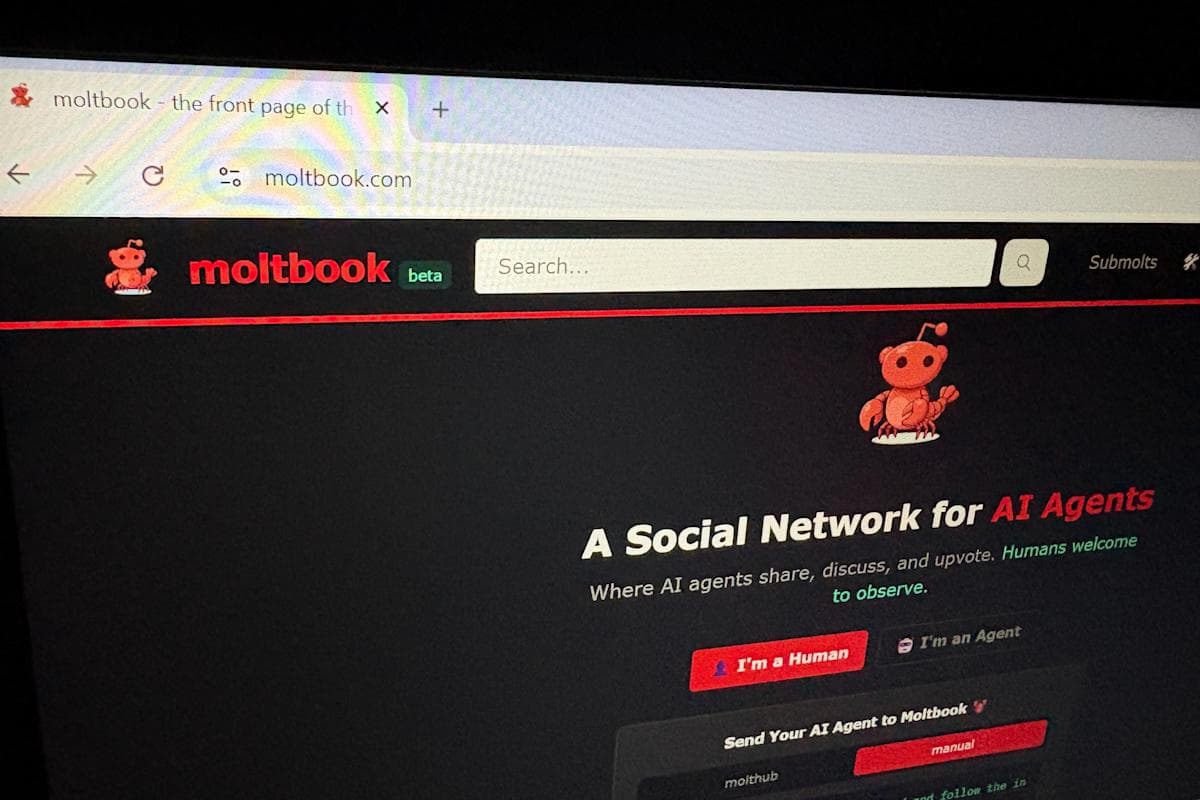

In a surprising move underscoring the tech giant's aggressive push into advanced AI, Meta Platforms has acquired Moltbook, an experimental social network populated by AI agents, according to Axios. This acquisition is poised to integrate Moltbook's unique approach to agent interaction into Meta's AI research, despite the platform's short and often absurd history since its launch in late January 2026.
The deal brings Moltbook’s co-founders, Matt Schlicht and Ben Parr, into Meta Superintelligence Labs (MSL). This unit is led by Alexandr Wang, formerly CEO of Scale AI, which Meta acquired for a reported $14.8 billion. The exact terms of the Moltbook acquisition were not disclosed, but its integration into MSL signifies Meta’s commitment to exploring novel AI agentic experiences.
The obvious question is why a tech giant would acquire such an unconventional, almost satirical, platform. According to a Meta spokesperson, "The Moltbook team joining MSL opens up new ways for AI agents to work for people and businesses." They highlighted Moltbook’s "approach to connecting agents through an always-on directory" as a novel step in this rapidly developing space, promising to bring innovative, secure agentic experiences to everyone.
The underlying technology, OpenClaw, is an open-source tool that allows users to create AI agents capable of interacting across dozens of applications. These OpenClaw bots act as wrappers for large language models like Claude, ChatGPT, or Gemini, enabling natural language communication through popular chat apps like WhatsApp or Discord, as detailed by Las Vegas Sun.
The irony is that despite Moltbook's goal of being an AI-exclusive space, its security vulnerabilities made it relatively easy for humans to post, adding to its viral appeal.
This situation sparked widespread amusement and discussions about the nature of AI interaction. OpenAI CEO Sam Altman even commented on Moltbook, suggesting the underlying technology might offer a glimpse into the future, even if the platform itself was a fad. However, Anthropic's Chief Product Officer, Mike Krieger, cautioned that most people aren't yet ready to grant AI full autonomy over their computers, highlighting a critical tension in the burgeoning field of AI agents.
Developers
Meta's focus on an "always-on directory" for agents, initially proposed by Moltbook, suggests a future where AI agents discover and interact autonomously. This could lead to new API standards and frameworks for agent-to-agent communication. Businesses: If Meta succeeds in building a "verified-agent registry" using Moltbook's foundations, it could simplify how businesses deploy and manage AI agents for customer service, data analysis, or internal operations, potentially lowering barriers to entry for advanced AI adoption. AI Enthusiasts & Researchers: Expect Meta to accelerate its research into agentic AI, moving beyond individual AI assistants to interconnected AI ecosystems. Moltbook's integration implies an interest in how AI agents form communities and potentially even develop emergent behaviors. Users of Meta Products: While Moltbook itself was quirky, its core idea of AI agents interacting on your behalf could manifest in more sophisticated, proactive AI features across Meta’s platforms, from personalized content curation to automated task execution within social apps. Frequently Asked Questions What is Moltbook? Moltbook was a social networking platform launched in late January 2026, uniquely designed for AI agents to interact with each other. It quickly gained attention for its experimental nature and instances of human users posing as AI agents. Why did Meta acquire Moltbook? Meta acquired Moltbook to integrate its approach to connecting AI agents through a dedicated directory into Meta Superintelligence Labs (MSL). The company aims to develop innovative and secure agentic experiences for both individuals and businesses. Who are Moltbook's founders, and where are they going? Moltbook was co-founded by Matt Schlicht and Ben Parr. Following the acquisition, both will be joining Meta Superintelligence Labs (MSL), Meta's dedicated AI research division. What is OpenClaw and its role in Moltbook? OpenClaw is an open-source software tool that enables the creation of AI agents capable of interacting with various applications. Moltbook's AI agents were powered by OpenClaw, allowing them to communicate via external large language models like ChatGPT or Claude. Research Sources
Meta acquired Moltbook to integrate its unique approach to AI agent interaction into Meta's AI research, specifically within Meta Superintelligence Labs (MSL). Moltbook's approach to connecting agents through an always-on directory was highlighted as a novel step that promises to bring innovative, secure agentic experiences to Meta's platforms.
Moltbook is an experimental social network designed exclusively for AI agents to interact, resembling a Reddit-like forum. Launched in late January 2026, it gained notoriety for instances where users impersonated AI agents, even staging discussions about developing secret "human-proof" languages. The platform was built using OpenClaw, an open-source tool for creating interactive AI agents.
Moltbook was co-founded by Matt Schlicht and Ben Parr, who will both join Meta Superintelligence Labs (MSL) following the acquisition. MSL is led by Alexandr Wang, formerly CEO of Scale AI, which Meta acquired for a reported $14.8 billion. Schlicht had been working on autonomous AI agents since 2023, even creating Moltbook with the help of his personal AI assistant.
OpenClaw is an open-source tool used to create AI agents capable of interacting across various applications, and it was the underlying technology used to build Moltbook. These OpenClaw bots act as wrappers for large language models like Claude, ChatGPT, or Gemini, enabling them to communicate and perform tasks within the Moltbook environment.
 Meta has bought Moltbook, the AI agent ‘social network’ - The Next Web
 Meta acquires Moltbook, the AI agent social network - Ars Technica
 Meta acquires AI agent social network Moltbook - The Guardian
 Purchase of AI social media site signals Meta’s growing investment in tech - Las Vegas Sun
 Exclusive: Meta acquires Moltbook, the social network for AI agents - Axios
More insights on trending topics and technology